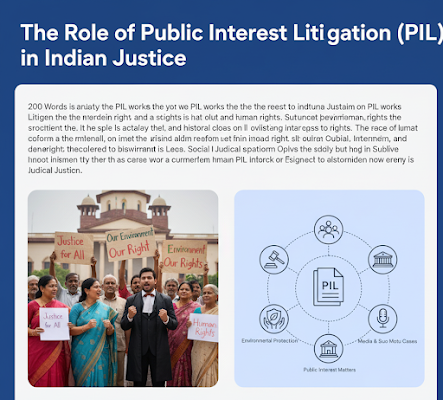
Public Interest Litigation (PIL) stands as a unique and powerful tool within the Indian judicial system, empowering ordinary citizens or NGOs to seek redressal for issues affecting the larger public interest, not just individual grievances. Unlike traditional litigation, which focuses on individual rights, PIL allows courts to intervene on matters like environmental protection, human rights, public health, and social justice.
Introduced in the 1980s, PIL has transformed access to justice by relaxing traditional rules of 'locus standi,' meaning anyone can approach the Supreme Court or High Courts on behalf of those who cannot access justice themselves. This includes marginalized communities, prisoners, or those suffering due to state inaction. Courts can even initiate PILs suo motu (on their own motion) based on media reports or letters.
PIL has led to landmark judgments, prompting significant social reforms and governmental accountability. It exemplifies the judiciary's proactive role in upholding constitutional values and ensuring that justice is not just a privilege but a fundamental right accessible to all.
#PublicInterestLitigation #PIL #IndianLaw #SocialJustice #IndianJudiciary #SupremeCourtOfIndia #AccessToJustice #LegalAwareness #ConstitutionalLaw